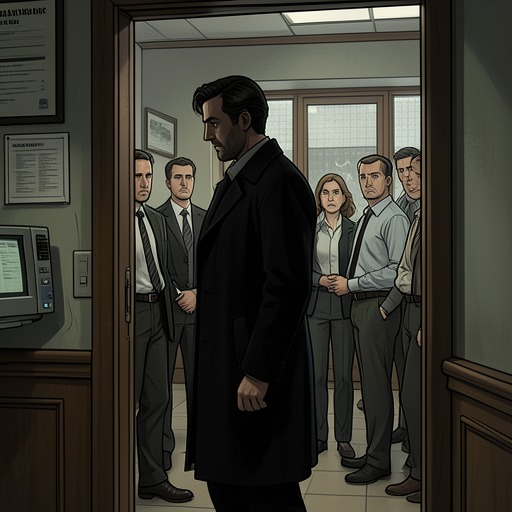
Nathan Gold
Dead ShotNathan Gold is the mayor who turns Statenville’s prosperity into an instrument of control. He presents himself as a disciplined civic leader and guardian of the town’s economic future, yet he is also the hidden criminal power behind its carefully managed secrecy. Gold’s public identity is eventually revealed as a refuge for Carmen Deangelo, a long-standing Boston mobster who established a respectable life in Statenville while continuing to build a criminal enterprise. His decisive significance lies in the contradiction he embodies: the town’s apparent stability, employment, and lawfulness are inseparable from the violence and information control used to sustain them.
Civic Architect and Public Respectability
Gold’s central political achievement is the consolidation of the Statenville Police Department with the Brooks County Sheriff’s Department. He conceived the merger after taking office twelve years earlier, when economic decline had not yet become the dominant concern of local, state, and federal governments. By combining resources and eliminating officers he considered unnecessary in a town where most residents obeyed the law, Gold gained popularity and acquired greater control over local law enforcement. Sheriff Hunter Jones welcomed the arrangement because it gave him more assets and authority, while Gold’s critics regarded the structure as an extension of his controlling temperament.
The consolidation appeared successful because Statenville prospered while neighboring communities struggled. Cloverdale Industries, described as the town’s major export business, transformed Statenville into a boomtown, and Gold’s administration could point to employment, civic confidence, and economic survival as evidence of sound leadership. His power therefore did not rest only on intimidation. It was reinforced by a material bargain: the town’s visible prosperity made his decisions difficult to challenge, even when the same decisions concentrated public authority in his hands.
Gold’s private study reflects the cultivated image he has built. Its dark oak walls and custom bookcase hold an extensive collection of worn rare books and literary masterpieces, suggesting that he values a home designed for literature more than a simple display of opulence. The contrast is deliberate in the characterization: Gold can inhabit the role of a thoughtful, ethical mayor while using that cultivated surface to conceal a system whose foundations are criminal.
The Secret Behind Statenville’s Prosperity
Gold knows that the town’s prosperity depends on a secret most residents never perceive. The secret is protected through a small inner circle, generous payments, and the conviction that public knowledge would threaten the entire civic structure. Gold’s reasoning repeatedly converts coercion into a supposed collective benefit. If employment and happiness come from criminal money, he asks himself whether ordinary residents would care about its source; yet those residents are never given the information necessary to make that choice. Their consent is manufactured through ignorance.
The arrangement extends beyond political influence. Gold places local law enforcement personnel on the Cloverdale Industries payroll, paying them weekly in laundered cash delivered in unmarked envelopes. This private payroll gives him immediate operational support whenever the official machinery of the town is insufficient. The resulting system makes the police and sheriff’s department appear public while allowing Gold to redirect their discretion toward protecting his interests.
The treatment of the three young deaths shows how this power operates at street level. Sheriff Jones tells Cal Murphy and Kelly Mendoza that Devin Reid, Jim Reid’s son, died from a simple drug overdose, despite the deaths occurring within a twenty-four-hour period. Jones says methamphetamine was found at all three scenes, while insisting that the toxicology reports from Boise will not be available for at least two weeks. In another conversation, Kevin Mendoza initially says that his findings suggest the victims bled to death, but a caller shuts down that conclusion and insists that they overdosed on drugs. Gold’s system therefore controls not only the investigation’s outcome but also the language through which death is officially understood.
Gold’s own family is caught inside this structure. He and his wife had known for months that their son Riley had begun experimenting with drugs, but they ignored the warning signs and never expected him to die. Riley’s death produces genuine grief, yet Gold suppresses it because the public acknowledgment of what happened would create personal embarrassment and endanger Statenville’s larger secret. His emotional conflict never displaces his political calculation; grief becomes another pressure to manage rather than a reason to abandon the system.
Repression of Investigation
Cal’s investigation threatens Gold because it challenges the division between the town’s public story and its concealed reality. Gold understands that an outsider working for The Register is unlikely to regard Statenville as a permanent home. To him, the town is merely a stop along a two-lane road, a cup of coffee before the reporter moves elsewhere. That apparent transience makes Cal especially dangerous: a reporter with little investment in local custom can ask the questions residents have learned not to ask.
Gold responds by treating lawful procedure as an adjustable tool. Cal is arrested on the inflated charges of possessing an open container and driving under the influence, even though he knows he was not driving with alcohol in his vehicle. The arrest is presented as a bullying tactic rather than a credible prosecution. Jake Dawkins books him, takes his mug shot, and mocks him throughout the process, while Sheriff Jones places him in a small jail cell. The episode demonstrates how Gold’s control reaches the ordinary encounter between a citizen and the law: the formal charge need not survive court if it can intimidate, delay, and isolate its target.
The pursuit escalates when Dawkins and rookie deputy Willie Warren are sent to investigate a supposed disturbance at Buddy Walker’s house. Sheriff Jones privately tells Dawkins that the real objective is to capture the town’s hottest fugitive, Cal, along with Kelly, and to arrest them on more fabricated charges. Dawkins takes his time because he does not believe the situation is dangerous, while Warren circles behind the house with his gun drawn to make the fugitives understand the seriousness of their position. Gold’s authority thus operates through layers of intermediaries: orders are softened into routine calls, coercion is disguised as procedure, and violence remains available when compliance fails.
Gold also directs pressure against Guy Thompson, the newspaper man whose long silence has helped preserve Statenville’s image. Guy has received a brown paper bag containing exactly one hundred twenty-dollar bills every month and has accepted a gentleman’s agreement not to search for the town’s secret. When Gold’s effort to remove Cal and Kelly intensifies, Guy realizes that his complicity may lead to the deaths of two reporters he has come to respect. Gold’s system depends on such compromises, but the danger of actual bloodshed forces Guy to reconsider whether the money is worth becoming responsible for their deaths.
From Control to Desperation
Gold’s confidence begins to fracture when he learns that a federal agent is working inside Cloverdale Industries with access to every room. This is not merely another trespasser whom he can buy or threaten. The danger becomes greater when he discovers that Buddy Walker has been working with another agent, creating uncertainty about how much of the operation has already been exposed. Gold tells himself that a single misstep will turn Statenville into a rural ghost town and destroy the good life he created, but the narration makes clear that this explanation mainly serves to soothe his conscience. His deepest concern is not the people’s welfare; it is the survival of his own power and criminal enterprise.
His response is to activate the network he has purchased. Gold takes satisfaction in remembering that every local law-enforcement employee has been added to the Cloverdale Industries payroll. The cash arrangement gives him the extra help he needs at the moment when official loyalty is no longer reliable. When he later confronts the reporters, he is no longer simply managing a political crisis from his study. He steps forward in the room with them, physically joining the threat and revealing how closely the mayor’s office, the criminal operation, and the enforcement apparatus have become fused.
Gold’s language toward Cal and Kelly exposes his contempt for independent scrutiny. When they are brought to Cold River Canyon in handcuffs, he describes them as the two burrs in his saddle and says he intends to crush them himself. Cal follows a deliberate script, claiming that he was only trying to discover what killed Gold’s son and did not realize that doing his job had made him such an irritation. Gold answers by condemning reporters as a debased profession whose members poke their noses where they do not belong. The exchange converts investigative journalism into a personal affront in Gold’s mind: truth is not a civic duty but an intrusion into the private property of power.
Identity, Death, and Exposure
Gold’s isolation becomes visible when he wakes late after spending the night waiting for news that Cal and Kelly have been captured. At 10:30 in the morning he abandons his usual coffee routine and calls Yukon Grant, his most trusted ally, only to reach voicemail. Yukon has vanished and has no intention of calling back. Gold then turns to Sheriff Jones for an update, revealing that the network he built through money and fear is beginning to dissolve at its edges.
His final confrontation takes place in Cold River Canyon, where he approaches the handcuffed Cal and Kelly with confidence, believing that physical control has restored the old order. Cal keeps him talking while Kelly prepares to document the exchange and signal the FBI sniper positioned on a ridge. Gold’s belief that he can still dictate the scene becomes the mechanism of his exposure: his threats and explanations are preserved as evidence while he imagines himself the one in command.
Cal warns Gold that imprisonment will be safer than sending his whereabouts to the Scarelli family and allowing them to return him to Boston with the FBI’s approval. Gold denies that Cal knows anything. Instead of surrendering, he turns and leaps into the canyon, joining Elliott Mercer in a fatal fall. The death is both an escape from immediate capture and the destruction of the identity he had maintained as Statenville’s respectable mayor.
A later newspaper report confirms the full revelation. FBI officials identify Carmen Deangelo as a long-standing Boston mobster who plummeted to his death in Cold River Canyon after murdering an FBI agent. Deangelo had nearly disappeared before moving to Statenville in 1996, establishing himself as a respectable community member and later running for mayor. The report emphasizes that he did not leave his criminal life behind when he entered civic society; he used Statenville as the place to construct another criminal life beneath a public one.
Narrative Role and Significance
Gold is the human center of Statenville’s corrupt power structure because he links economic prosperity, law enforcement, media suppression, and organized crime. His political reforms are not presented as meaningless: the consolidation makes the town more efficient, and Cloverdale Industries genuinely provides employment. The corruption lies in the hidden exchange beneath those achievements, where civic resources and public trust are redirected toward protecting illicit wealth.
His characterization also depends on self-justification. Gold repeatedly tells himself that repression is necessary for the common good, that blood money is preferable to more conspicuous murder, and that residents are better off living inside a prosperous illusion. The result is a ruler who does not need to see himself as a villain in order to authorize villainous acts. He can admire literature, grieve his son, and speak of ethics while treating other people as pawns in a scheme whose costs they were never allowed to evaluate.
The fate of Nathan Gold therefore completes the book’s central exposure of Statenville. The town’s neat surface is not sustained by a single secret kept by one man, but Gold gives that secret its governing philosophy and institutional reach. Once Cal Murphy and Kelly Mendoza force the hidden structure into the open, the mayor’s public identity and Carmen Deangelo’s criminal identity collapse together. His leap into Cold River Canyon ends his life, but it also marks the failure of the fantasy that prosperity can cleanse the violence that produces it.